← Back to Boards
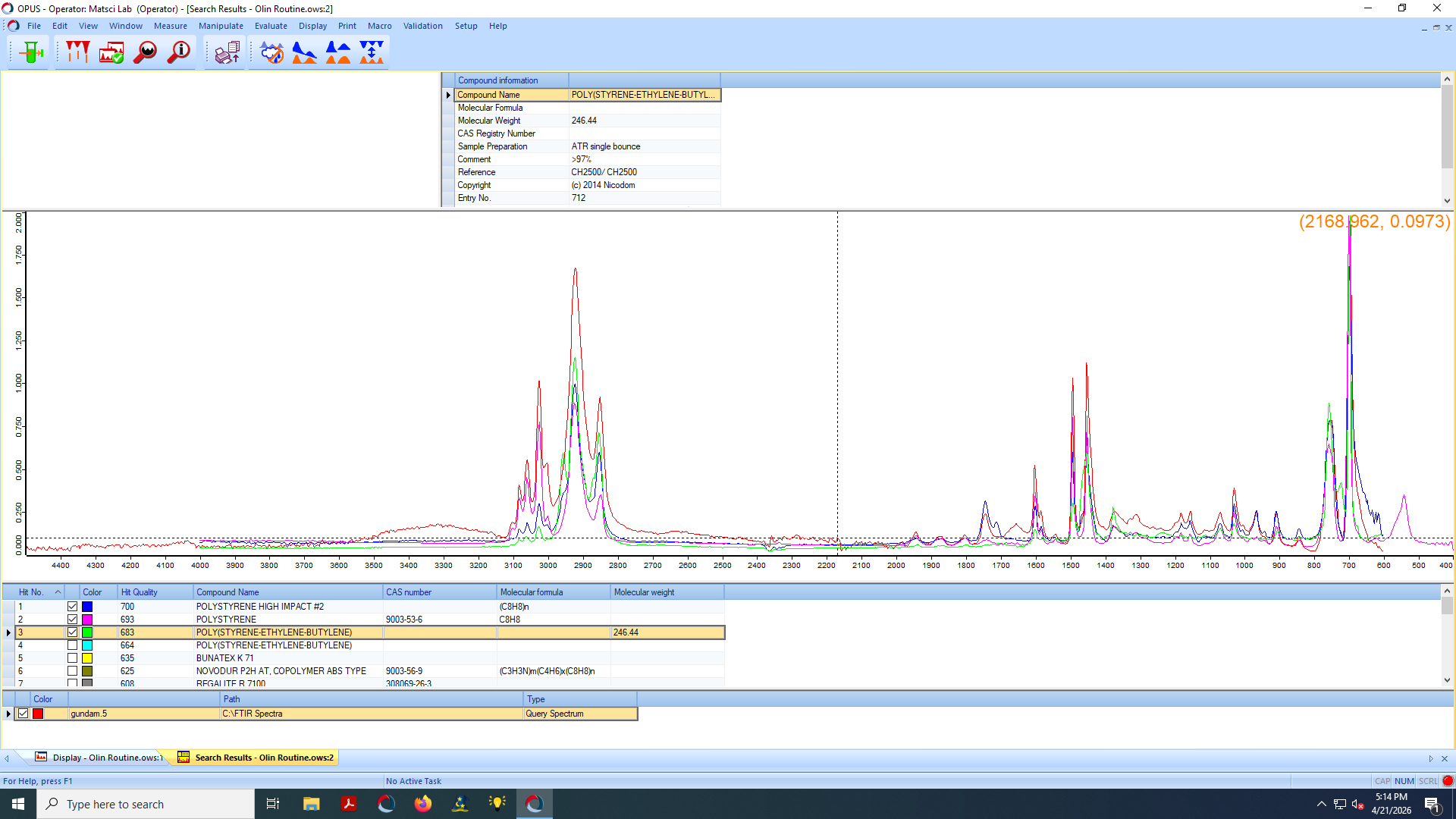
The full HG 1/144 Wing Gundam runner set laid out before assembly.
Figure 1. The full HG 1/144 Wing Gundam runner set as it came out of the box. Each runner is a single mold cycle's worth of parts — the rigid structural runners fall in the styrenic family (HIPS / PS-rich HIPS), while the small dark runner in the lower right is the polyethylene polycap frame (PC7).

3. Origin and Materials

3.1 Why I Started Asking

As a kid I assumed the parts of a GunPla kit were all the same plastic because they all came in the same box. I also assumed that the McRib actually had baby back ribs in them. Both turned out to be false. For example, while the white armor pieces are stiff and glossy, the little black bushings between the joints are soft, slightly waxy, and visibly different even without pigment. They also behave differently under load.

I sampled three plastic forms from a Bandai HG 1/144 Wing Gundam kit and analyzed each by FTIR spectroscopy in attenuated-total-reflectance (ATR) mode against a commercial polymer reference library. SB-13 and Board A are both rigid, glassy runner samples. PC7 is the polycap runner of black, rubber-like joint inserts and feels soft.
3
Plastic forms checked by FTIR
~30 g
Styrenic rigid plastic per HG 1/144 kit (typical)
~5 g
LLDPE polycaps per kit (typical)

3.2 SB-13 Runner — High Impact Polystyrene (HIPS)

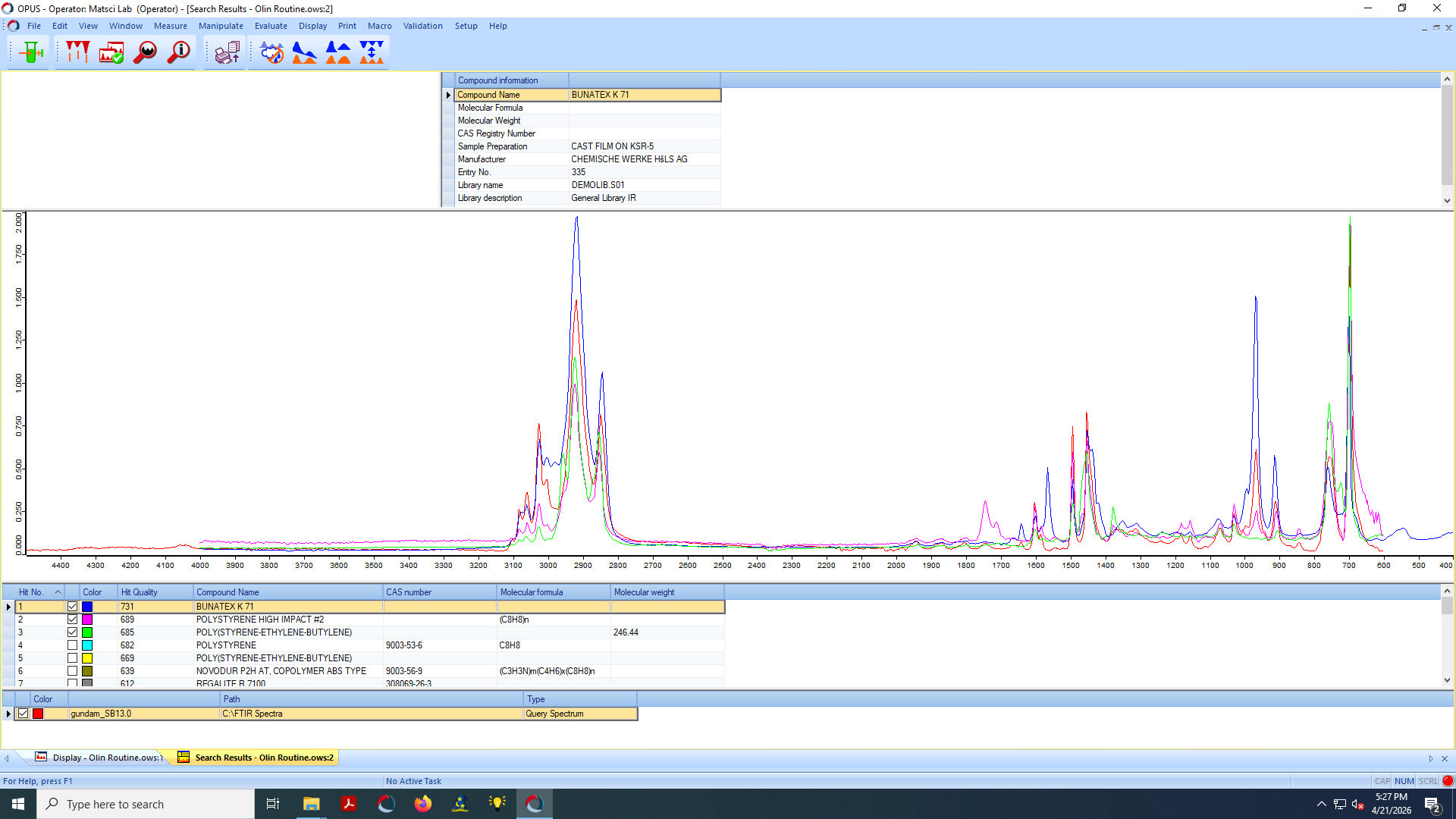
I ran an FTIR-ATR scan of an SB-13 sample against the spectrometer's polymer reference library. The top three matches were "Polystyrene High Impact (Butyl)", "Bunatex" (a polybutadiene rubber brand), and a polystyrene-ethylene-butylene block copolymer. All three converge on the same material class: High Impact Polystyrene (HIPS) — a rubber-toughened polystyrene rather than general-purpose PS.

HIPS is a rubber-modified thermoplastic in which 5–15 wt.% polybutadiene is dispersed as roughly 1–3 μm domains throughout a rigid polystyrene continuous phase. The rubber phase absorbs and dissipates impact energy by initiating multiple silver-craze bands rather than allowing a single fast-propagating crack — which is why HIPS armor can take a snap-fit insertion force without spider-cracking around the peg.

FTIR Top Matches — SB-13

Polystyrene High Impact (Butyl) · Bunatex (rubber-modified styrenic) · Polystyrene-ethylene-butylene block copolymer

FTIR-ATR spectrum of SB-13 sample with library hits for impact polystyrene.
Figure 2. FTIR-ATR spectrum export for the SB-13 sample (query trace in red), with library search hits consistent with high-impact / rubber-modified polystyrene — matching the HIPS assignment in §3.2.
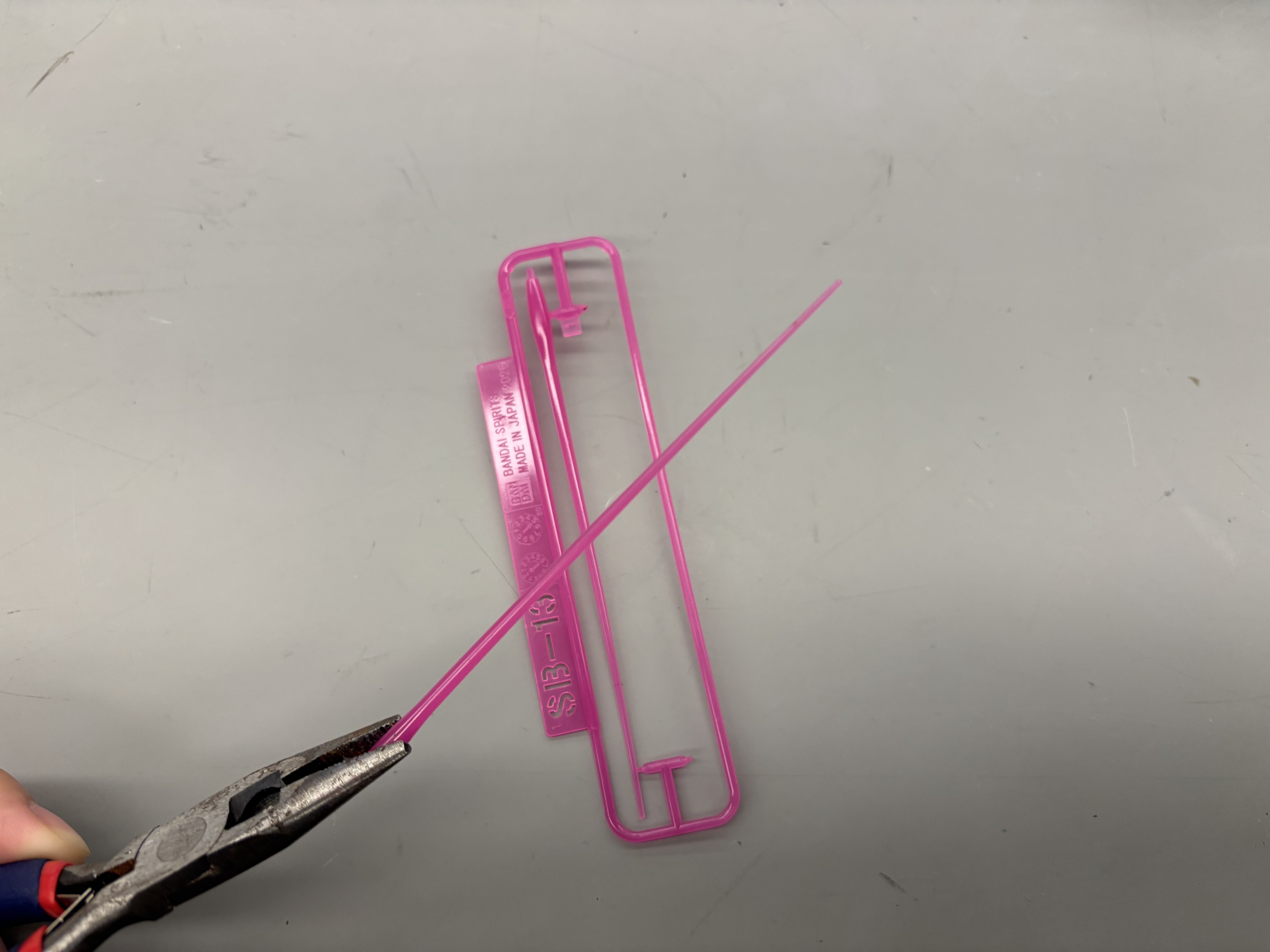
SB-13 rigid styrenic runner sample held in tweezers.
Figure 3. SB-13 runner sample held in tweezers after cutting. The rigid, glossy behavior matches the FTIR assignment to a hard styrenic material rather than the flexible polyethylene used for the polycaps.

3.3 Board A Runner — PS-Rich Styrenic Blend

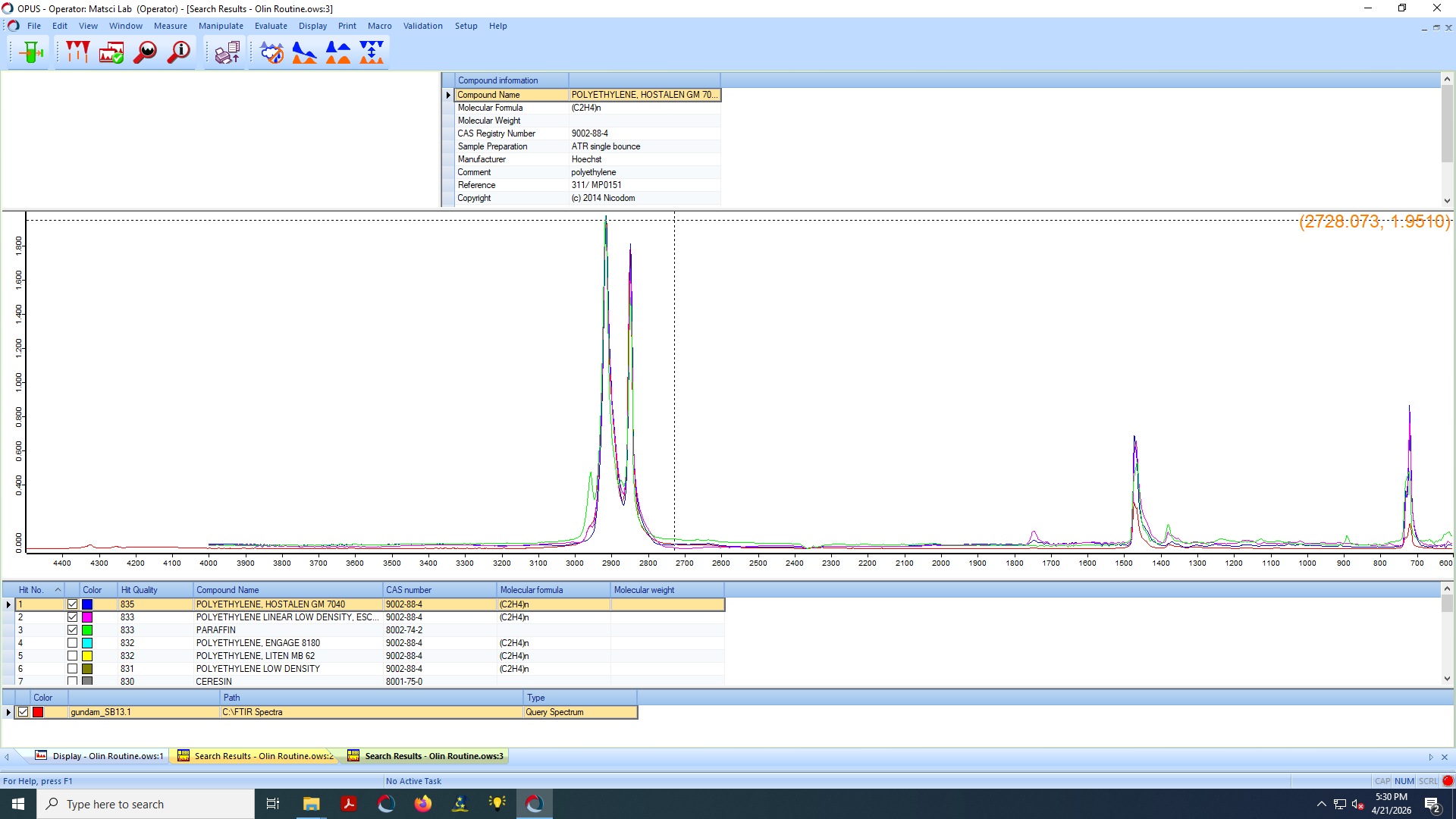
The Board A spectrum identifies the sample as a polystyrene-based rigid runner. Its library top matches were "Polystyrene High Impact #2", "Polystyrene", and "Poly(styrene-ethylene-butylene)". All three matches contain a styrenic component, which puts Board A in the same broad family as SB-13 and clearly separates it from PC7, whose spectrum matched polyethylene grades instead.

Board A is not identical to SB-13, though. SB-13 gave three hits that all pointed toward impact-modified polystyrene: HIPS, a polybutadiene rubber reference, and a styrenic block copolymer. Board A gave one HIPS hit, one plain polystyrene hit, and one styrenic elastomer / block-copolymer hit. That pattern suggests a PS-rich rigid formulation: either a HIPS grade with less rubber detected by ATR, or a mostly polystyrene runner modified just enough to resemble impact-modified styrenics in the library search.

My assignment for Board A is therefore PS-rich styrenic hard-runner plastic. It should be grouped with SB-13 for function and broad chemistry, because both are rigid polystyrene-family materials. It should not be grouped with PC7, which is the separate polyethylene polycap material. The practical conclusion is that the kit uses multiple styrenic formulations for hard parts, plus polyethylene for the flexible joint inserts.

FTIR Top Matches — Board A

Polystyrene High Impact #2 · Polystyrene · Poly(styrene-ethylene-butylene)

FTIR-ATR spectrum of Board A sample with library hits for high-impact polystyrene, polystyrene, and poly(styrene-ethylene-butylene).
Figure 4. FTIR-ATR spectrum export for the Board A sample. The library hits sit in the same styrenic family as SB-13, but the plain-polystyrene match suggests a PS-rich hard-runner formulation rather than an exact duplicate of the SB-13 HIPS assignment.

3.4 PC7 Runner — Polyethylene-Based Polycap

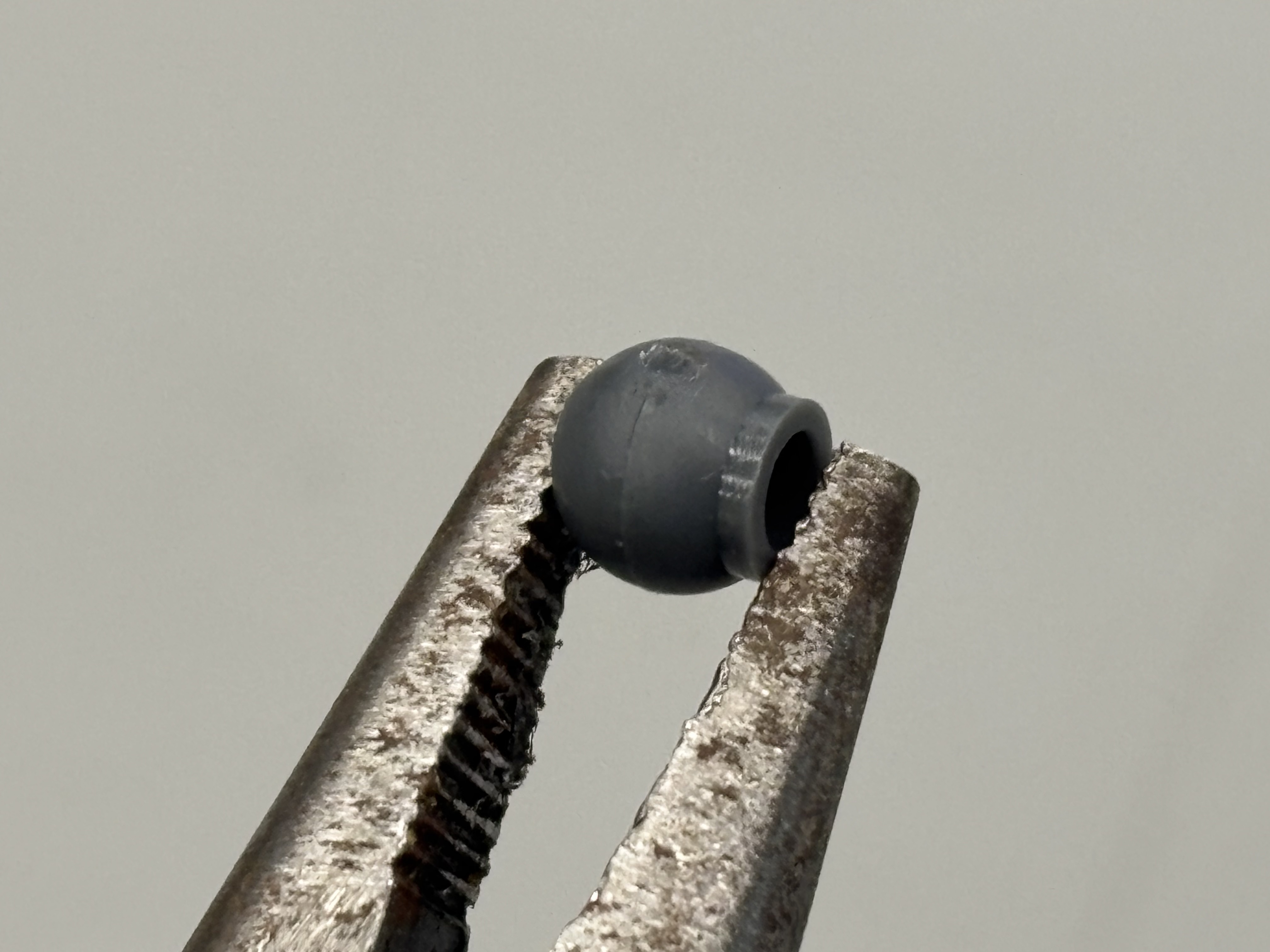
FTIR-ATR spectrum of PC7 sample with polyethylene library matches.
Figure 5. FTIR-ATR spectrum export for the PC7 sample — library matches cluster on polyethylene grades (e.g. LLDPE-class Hostalen references), matching the joint-insert chemistry described in §3.4.

The PC7 runner supplies the dark polycap parts that act as joint bushings in HG and most MG kits. Unlike the rigid SB-13 and Board A pieces, polycaps are designed to flex and provide a press-fit interference connection that retains its grip over many cycles of pose changes.

The library top matches for the PC7 spectrum were "Polyethylene Hostalen GM 7040" (a LyondellBasell polyethylene grade), "Polyethylene linear low density", and "Paraffin." These are all consistent with a polyethylene-based polycap, with paraffin most likely present as a processing aid rather than a major structural component.

The pliability of the polycap comes from polyethylene's intrinsic combination of high backbone flexibility and partial crystallinity (≈30–55% for LLDPE).

FTIR Top Matches — PC7

Polyethylene Hostalen GM 7040 (LyondellBasell) · Polyethylene linear low density · Paraffin (processing aid)

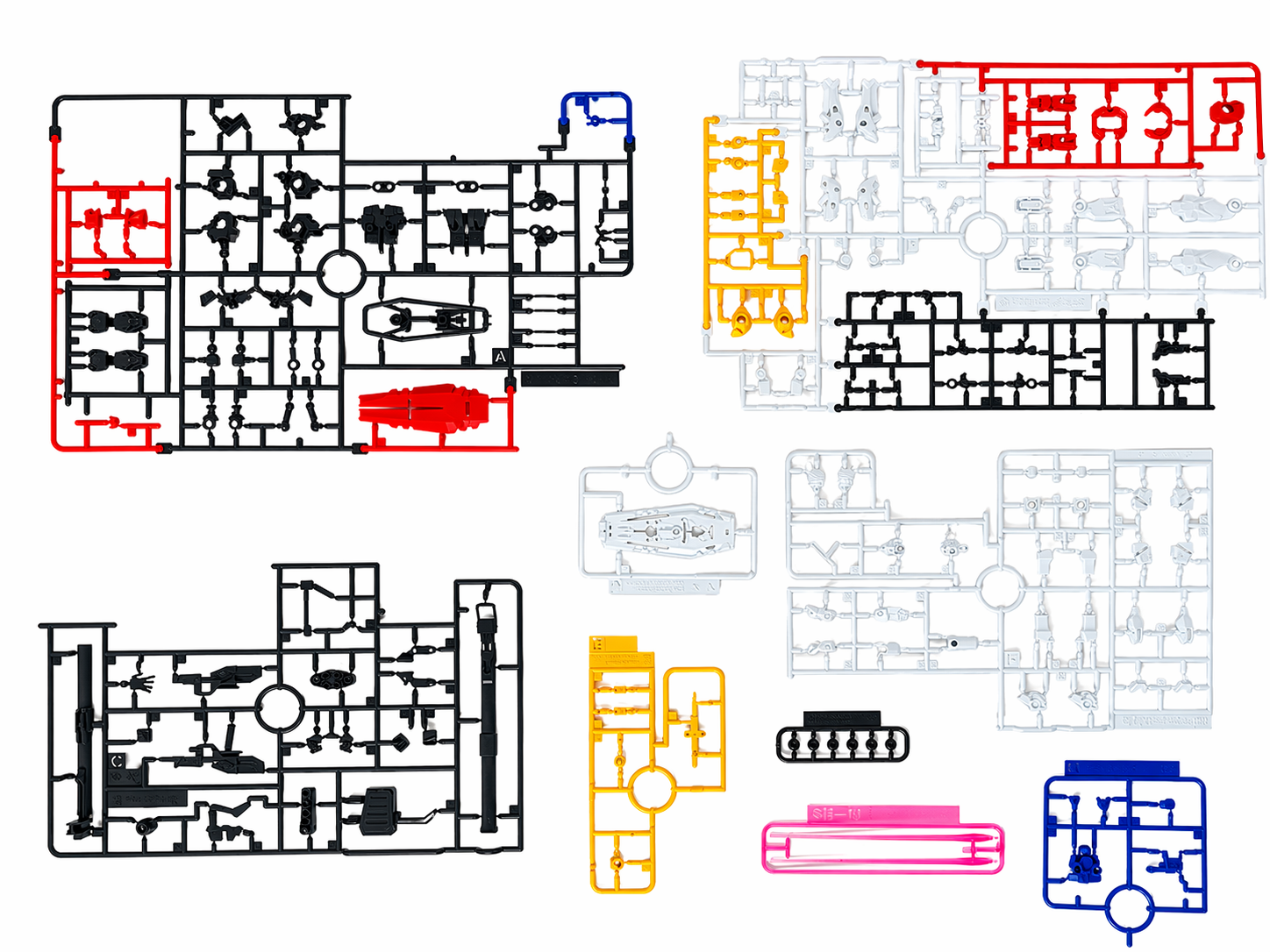
Single polycap held in tweezers.
Figure 6. A single PC7 polycap held in tweezers. LLDPE's combination of low modulus and partial crystallinity means the bushing can deform locally to accept a HIPS peg, then spring back to maintain joint grip across thousands of cycles.

3.5 Why These Polymer Families?

Pairing a stiff amorphous styrenic runner family with a soft semicrystalline polyolefin is a strategic decision rather than a cost decision. SB-13 and Board A supply rigid parts with fine surface detail and paint receptivity, even though they do not appear to be identical formulations, likely due to color requirements and design constraints (SB-13 is a semi-clear thin weapon that is not load bearing, whereas Board A is the solid-colored body of the kit). LLDPE supplies compliant polycap joints with elastic recovery and low surface energy for smooth re-posing. The split is functional: hard styrenic plastics for visible structure, compliant polyethylene for moving joints.

Engineering Fun Fact

Stiff matrix plus compliant joint is the same strategy used in interference-fit medical-device hubs and automotive grommets! GunPla applies it at toy scale, with the additional constraint that the consumer must be able to assemble the joint with bare hands and no adhesive.