← Back to Boards
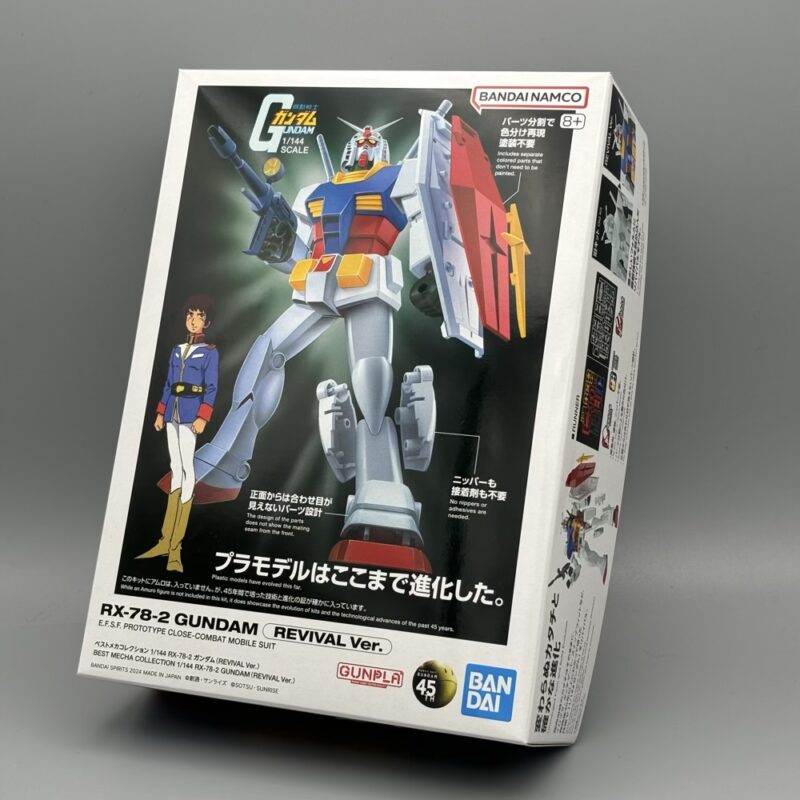
Best Mecha Collection 1/144 RX-78-2 Gundam Revival Ver. package.
Figure 1. Best Mecha Collection 1/144 RX-78-2 Gundam (REVIVAL Ver.) package. Bandai's official 2024 revival keeps the early 1/144 kit language visible while folding in color separation, touch gates, and snap-fit design that did not exist in the 1980 launch kit. Source: The Gundam Base official blog.

2. History Since 1979

2.1 Why the History Matters Here

The Wing Gundam kit in front of us is a 30-gram piece of plastic with measurable mechanical properties. From the multi-color runner to the polycap socket geometry, every choice is the product of a specific historical sequence at Bandai. The HG grade did not exist until 1990. The polycap system did not exist before that. The Wing Gundam itself was not designed until 1995 and was redesigned in 1997. Reading the kit without the history leaves you looking at the shape without the process that produced it.

GunPla's engineering history runs in parallel with Bandai's capacity to mold ever more parts at ever finer detail. Each grade introduction below brought an engineering capability that was new at the time of its release.
1980
First GunPla released (1/144 RX-78-2) [Fact Book]
810.72M
Cumulative Gundam series model-kit shipments by March 2025 [Fact Book]
46 yr
From the 1980 kit launch to 2026

2.2 Grade Timeline

  • 1979
    Mobile Suit Gundam premieres on Nagoya Broadcasting on 7 April 1979, directed by Yoshiyuki Tomino. The show redefines the "real robot" mecha sub-genre by treating giant machines as fallible military hardware.
  • 1980
    Bandai releases the first GunPla, a 1/144 RX-78-2, in July. Early kits were monochrome and required paint and glue to match the box art.
  • 1990
    Introduction of the High Grade (HG) line: the first GunPla designed for full snap-fit assembly with multi-color injection molding and an articulated internal frame.
  • 1995
    Introduction of the Master Grade (MG) line at 1/100 scale: more parts, finer surface detail, full inner-frame skeleton. Also the year the Wing Gundam was designed by Kunio Ōkawara for Gundam Wing.
  • 1997
    Hajime Katoki redesigns the Wing Gundam for the Endless Waltz OVA. Current HG kits descend from this redesign, which blends 1995-era proportions with updated engineering.
  • 1998
    Introduction of the Perfect Grade (PG) line at 1/60 scale: hundreds of parts, electronic LED options, and metal-pin reinforcement at high-load joints.
  • 2006
    Bandai completes the Bandai Hobby Center in Shizuoka, Japan as a plastic-model production base. Bandai later describes the site as using original four-color injection molding machines capable of molding four colors and four materials in one mold [Bandai].
  • 2010
    Introduction of the Real Grade (RG) line at 1/144 scale: back-porting the inner-frame and surface-detail philosophy of MG into the HG form factor. Finest detail at smallest scale to date.
  • 2021
    Launch of the GunPla Recycling Project: in-store runner collection plus material, chemical, and thermal recycling pathways [Bandai].
  • 2021-25
    Bandai Namco reports approximately 117 t of runners collected from April 2021 through March 2025, including 37 t in fiscal 2024 [Bandai]. "GunPla Academia" reaches approximately 520,000 elementary-school participants across approximately 7,100 schools by March 2024 [Bandai].
  • 2025
    Mobile Suit Gundam GQuuuuuuX is released and highly viral. The series aimed at newcomers continues with new releases like the CHARZAKU-KUN DX Set (June 2025).

2.3 The Wing Gundam in Context

The Wing Gundam (XXXG-01W) examined in this report carries 1995-era proportions (long limbs, transformable bird-mode wings) and 2010s-era engineering (RG/HG-class snap-fit polycap articulation).

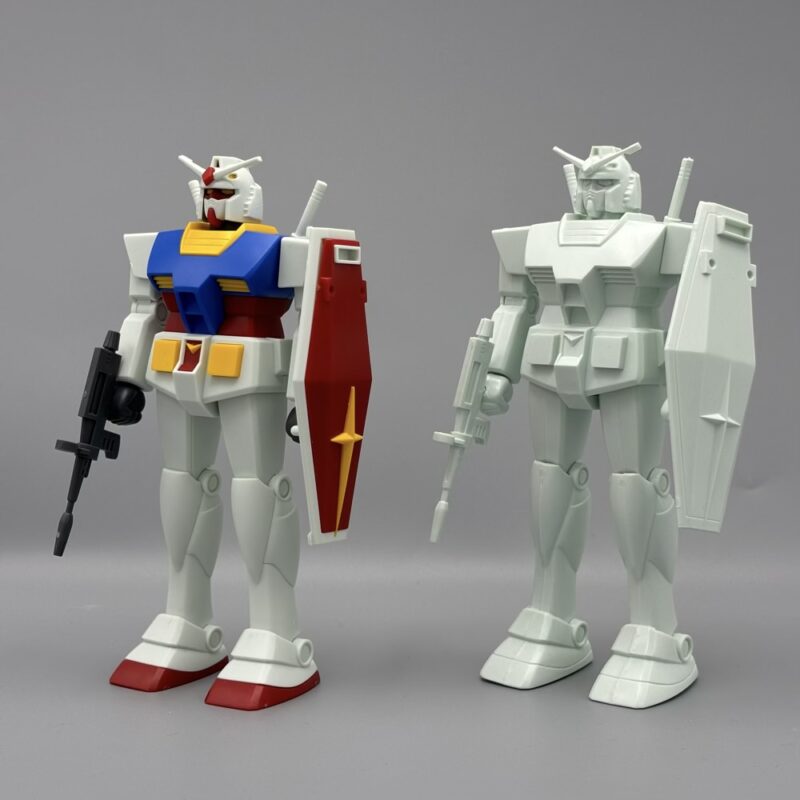
Comparison of a modern Best Mecha Collection Revival kit and the earlier 1/144 Gundam form.
Figure 3. Bandai comparison of the modern Best Mecha Collection REVIVAL Ver. with the earlier 1/144 Gundam form on the right. The visible difference is not only styling; it is the history of color-separated molding, snap-fit design, and part-count control compressed into one 1/144-scale comparison. Source: The Gundam Base official blog.