I grew up around GunPla, even though I was never brave enough to actually build them as a kid. My dad usually had one or two displayed in the cabinet next to our dining table, and I remember being drawn to their precision. They were small, detailed, articulated objects that felt more engineered than playful. They did not really register with me as toys; instead, they were art that had been designed, manufactured, assembled, and posed with intention. I have still only watched maybe three episodes of Mobile Suit Gundam, so my interest in Gundam does not really come from the anime itself. It comes from the physical kits: the parts, the runners, the snap-fit joints, the layered armor, and the process of turning plastic pieces into something that feels mechanically believable.

1. Cultural Impact of Gundam and Gundam Model Kits
1.1 My Relationship with GunPla
1.2 Cultural Identity Beyond the Anime
Gundam plastic models, usually shortened to “GunPla,” sit in a strange middle ground between consumer product, engineered object, hobby material, and cultural artifact. Their value does not depend entirely on whether someone has watched the source material. In my case, the model kits came first, and the media came much later. A GunPla kit is meaningful for its design, assembly experience, plastic quality, articulation, color separation, and display value, not solely for the story or character it represents.
1.3 Accessibility and Skill Progression
A beginner can buy a small Entry Grade or High Grade kit for roughly the price of a meal, with U.S. retail examples around $10-21 for Entry Grade RX-78-2 and HGAC Wing Gundam kits [Gundam Planet] [Republic], while more complex Perfect Grade kits can be hundreds of dollars, with PG Unleashed RX-78-2 listed around $299 in one current retail example [Gundam Planet]. Someone can start with a simple snap-fit kit and no paint, glue, or specialized tools (the kit analyzed here is one of those), then gradually move toward sanding, panel lining, painting, weathering, kitbashing, and full custom builds. Gunpla is seen across different levels of material engagement: a mass-produced plastic object, an assembly exercise, a display model, and a customized craft piece.
1.4 Scale and Community
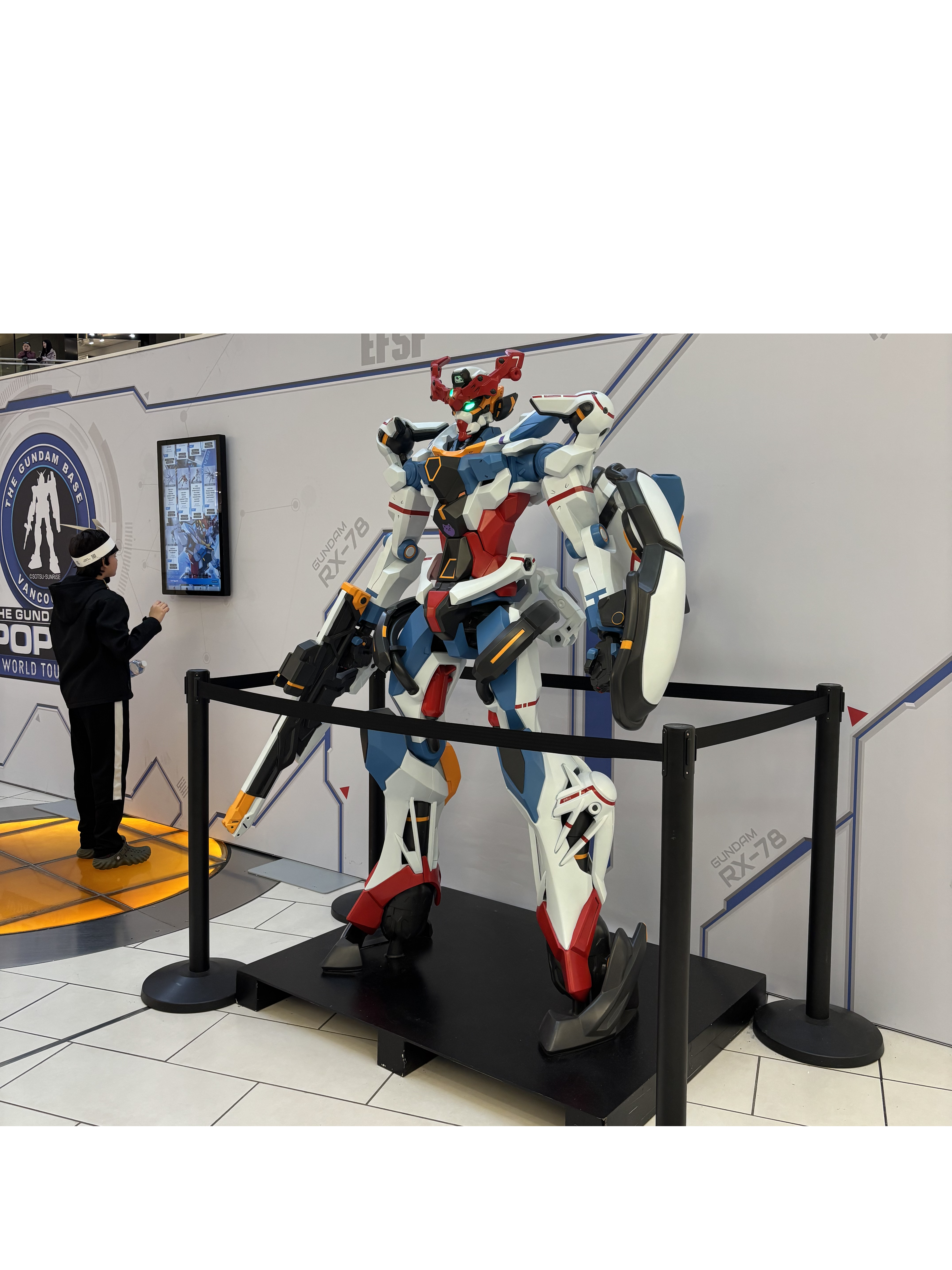
The scale of the hobby makes this more than a niche collector market. Bandai Namco's 2025 Fact Book reports 810.72 million cumulative shipments of Gundam series model kits as of March 2025 [Fact Book], indicating that GunPla has reached a level of production normally associated with major global consumer products rather than specialty model kits. The community around it is similarly international. Builders share work-in-progress photos, custom paint jobs, competition builds, reviews, tutorials, and display setups across forums, YouTube, Reddit, Instagram, conventions, and official events. In the case of GunPla, the material object becomes a shared language for a global hobby community.
1.5 From Culture to History
The first GunPla kit, a 1/144 scale RX-78-2 Gundam, was released by Bandai in July 1980, about one year after Yoshiyuki Tomino’s Mobile Suit Gundam first aired on Nagoya Broadcasting on April 7, 1979. The anime is widely credited with helping redefine the "real robot" sub-genre of mecha anime. Instead of presenting giant robots as magical or superpowered heroes, Mobile Suit Gundam treated them more like military hardware: machines built, maintained, deployed, damaged, and operated by human pilots with political and personal limitations. That shift made the mobile suits feel less like fantasy characters and more like plausible industrial objects, which sets up the historical timeline in Section 2.
Bandai Spirits' 2024 Hobby Center expansion plan lists 10 multi-color molding machines and 84 mono-color molding machines at full operation, with production expected to rise by approximately 35% compared with fiscal 2023 [Bandai]. The kits are now a Japanese soft-power export: the "GunPla Academia" educational program engaged approximately 520,000 children across 7,100 elementary schools by March 2024 [Bandai].